
History of the Prince Edward Island Crafts Council
With much gratitude, we would like to acknowledege that the history of the PEI Crafts Council was researched and written by Katie Keizer and Breanna MacDougall of Eptek in 2025 for our 60th anniversary exhibit, using archival documents from the PEI Crafts Council.
-
In 1964, the Listers, a couple originally from New Brunswick, visited Prince Edward Island, where they had been told they would find ‘quality craft.’
Muriel Lister, who was to become the Provincial Handicraft Director of the Prince Edward Island Department of Tourist Development, recognized the potential of a local craft community as a growing aspect to Atlantic Canadian tourism. Along with her husband Percy Lister, Muriel had previously led crafting programs, particularly weaving, in New Brunswick.
They toured the Confederation Centre of the Arts in 1964, and upon looking around the newly built arts space remarked, ‘what a great place to have a craft show.’ They held an independent craft fair at the Confederation Centre in November 1964, inviting craft artists from both the Island and the mainland. It was this fair that sparked the embers of what would become the PEI Crafts Council.
-
On February 13, 1965, in Room 66 of the Prince of Wales College, the idea of a council dedicated to governing, training, showcasing and selling fine Island craft was first proposed. In addition to the Listers, the first meeting of the ‘Craftsmen’s Council’ inducted Donald Stewart as President, Blanche England as Vice-President Kings County, Inez Dixon as Vice-President Prince County, Mary Burnett as Secretary, and Dan Mullen as Treasurer. A temporary Standards Committee and a Public Relations Committee were also formed, and plans were made for the first actions of the Council.
By April of 1965, the by-laws of the Council had been drafted, and by May, the organizational constitution for the Craftsmen’s Council of Prince Edward Island was presented by the provincial government with a grant of $350. The fall of 1965 brought with it plans for the Council’s ‘very own’ craft fair.
-
The Council’s success started slowly and without profit. The first Christmas Craft Fair was held in the upper foyer of the Confederation Centre of the Arts on November 19th and 20th, 1965. Even with an entry fee of $2.00 for individual artists, and extensive promotion to the public, the craft fair closed with a deficit. However, when the Council reconvened in early 1966, they formed an improved plan which followed their guidelines to exhibit, sell and teach craft.
More fairs were developed, expanding from single day to multiple day events. The Confederation Centre for the Arts was the staple location; however, the Council partnered with the Women’s Institute to host and jury a craft fair at the Olde Home Week Exhibition. The standards set by the Council meant that not just anything could be sold, all entries to fairs had to meet jury standards. This set a precedent for producing and displaying fine craft.
Programs were put in place to teach interested people different craft techniques. The Council’s programs initially operated in the Arts and Crafts Movement model, where products were taught and made in the home rather than in a central location. For example, Mary Black, a master weaver from Nova Scotia, was brought to the Island. Mary would travel to the home of the artist, assist them in setting up a loom and warp winding equipment. She gave instructions on how to thread the loom and then would revisit the artist every few weeks to see their progress and offer guidance. In this style, the programs were able to grow to incorporate more forms of craft, and artists were able to use traditional techniques to develop their own method.
-
The in-home style of training was limited and eventually a Handcraft Training Centre was proposed to train artists in different forms of craft. Initially, the Listers ran the Handcraft Training Centre, but unfortunately were killed in a tragic car accident in 1970. Joan Auld was then brought in to lead the Training Centre. Joan was trained as a weaver at NSCAD and was the Craft Development Officer with the PEI Department of Business Development for 30 years. Skilled craftspeople from Island co-ops and guilds became extremely important to the Council as a resource to teach various mediums, as the Island had an established community of craft co-operatives and guilds.
Joan developed a plan to acquire a building to house the Training Centre. She was granted the funds from the federal government and set to work immediately designing the plans for a school, gallery, reception space and offices. The concept included offices for the Craft Council on location, as well as offices for government heads and managers. The training centre was intended to act as a wholesaler showroom for artists, as well as a supply centre.
The teaching program was designed to teach leather, metal, jewelry, pottery and wood. The artists would train for 8 weeks and rotate to each area before deciding on one ‘major’ to focus on. The program took two years to complete. The program was later incorporated into the high school vocational program. Built with federal funding, the program offered Prince Edward Island students the opportunity to receive a high school diploma and receive a trade certification. -
As membership of the Council grew, members were granted the opportunity to attend and showcase their crafts on a national and international stage. Attending craft conferences across Canada, the Americas and even as far afield as Kyoto, Japan, Island artists brought fine craft from Prince Edward Island to the attention of the world.
The Handcraft Training Centre was relocated to West Royalty in the early 1970’s from its original location on Prince St. in Charlottetown. Eventually, it was incorporated into the newly established Holland College and became the Holland College School of Visual Arts. The high school vocational program started by the Council became the precursor for the Red Seal Certification Program.
It was decided that to fulfill the final part of the Crafts Council’s goal, a shop needed to be established, to sell the fine craft that was being produced. On October 6, 1980, a shop was opened on Victoria Row in Charlottetown. This shop acted as a centralized location for the PEI Crafts Council and was kept well stocked by practicing artists.
-
Today, the Prince Edward Island Crafts Council carries the same mandate: educate, sell and exhibit fine Island craft. The Council’s shop eventually moved from Victoria Row to Water Street. With funding and support from Innovation PEI the Council continues to operate out of Charlottetown, offering an exhibition, shop and studio spaces to artists. Membership has grown to over 170 artists and workshops taught by Council members and invited international instructors continue to educate the public interested in fine craft. To this day, the PEI Crafts Council hosts the oldest craft fair on Prince Edward Island. The Council has established a culture of creativity and facilitated a community of working artists on PEI. For six decades the PEI Crafts Council has been setting a standard for the production and appreciation of fine craft on Prince Edward Island and continues to do so for many years to come.
-
In 2003, the Prince Edward Island Crafts Council declared a year-long “Celebration of Crafts” to increase awareness and promote the Island’s handcraft sector, attract youth to a future in the craft sector and give recognition and acknowledgment to the accomplishments of existing craftspeople.
With plans beginning in 2002, an exhibition of fine craft called ‘Enriching Island Culture’ was to be held at Eptek Art & Culture Centre for the summer of 2003 as one component of the many activities the PEI Crafts Council organized in the year-long celebration. An exhibition committee comprised of Nonie Fraser, site director of Eptek, Irene Renauld, executive director of the PEI Crafts Council, and Craft Development Officer Carolyn Villard from PEI Business Development, among many others, oversaw all exhibit activities and planning.
This exhibit highlighted the multifaceted work of 50 innovative and skilled Island artisans in various mediums, techniques and materials. ‘Celebration of Crafts: Enriching Island Culture’ ran from June 8 – October 12, 2003, with a total attendance of over 16,300 visitors, demonstrating the success and importance of the Island’s handcraft sector.
From the success of the inaugural exhibition, a 22-year-long partnership blossomed between the PEI Crafts Council and Eptek Art & Culture Centre. Since 2003, they’ve collaborated on a series of exhibitions taking place every four years, inspiring artisans to stretch beyond their usual product lines, and showcasing the value of craft: its economic impact, its contributions to our cultural traditions, and—above all—its inherent creative value.
It all began
with a fair
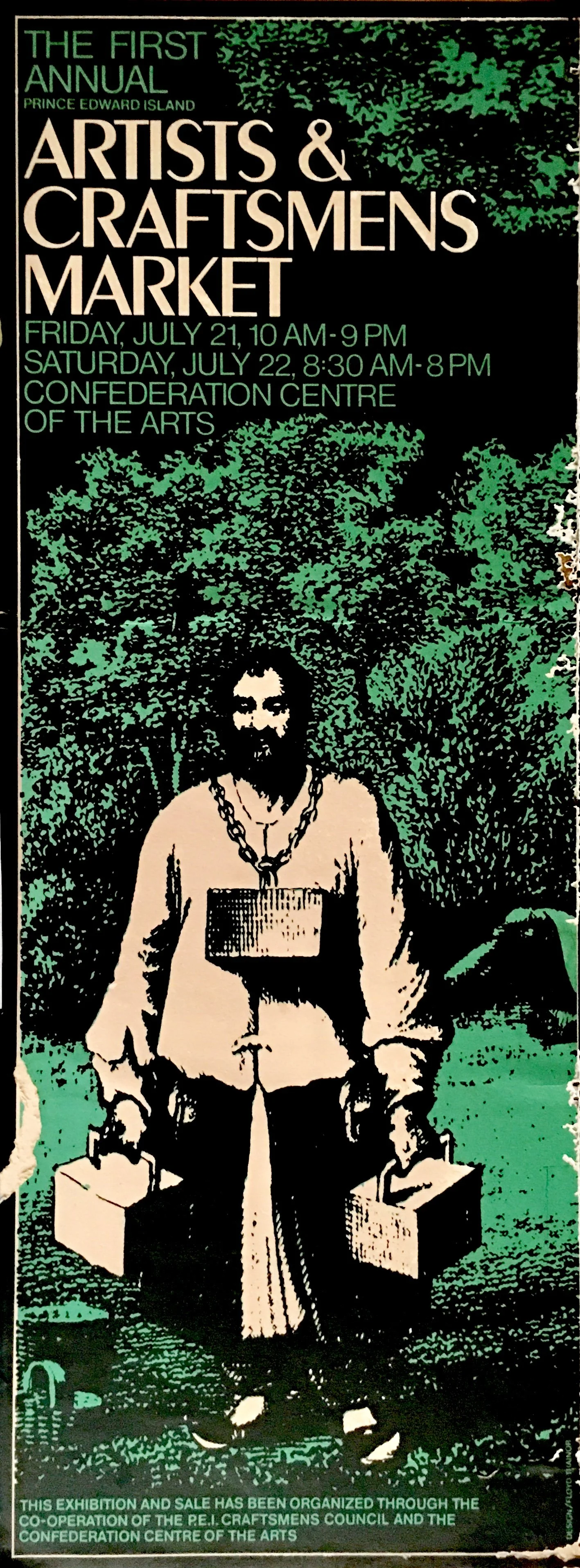
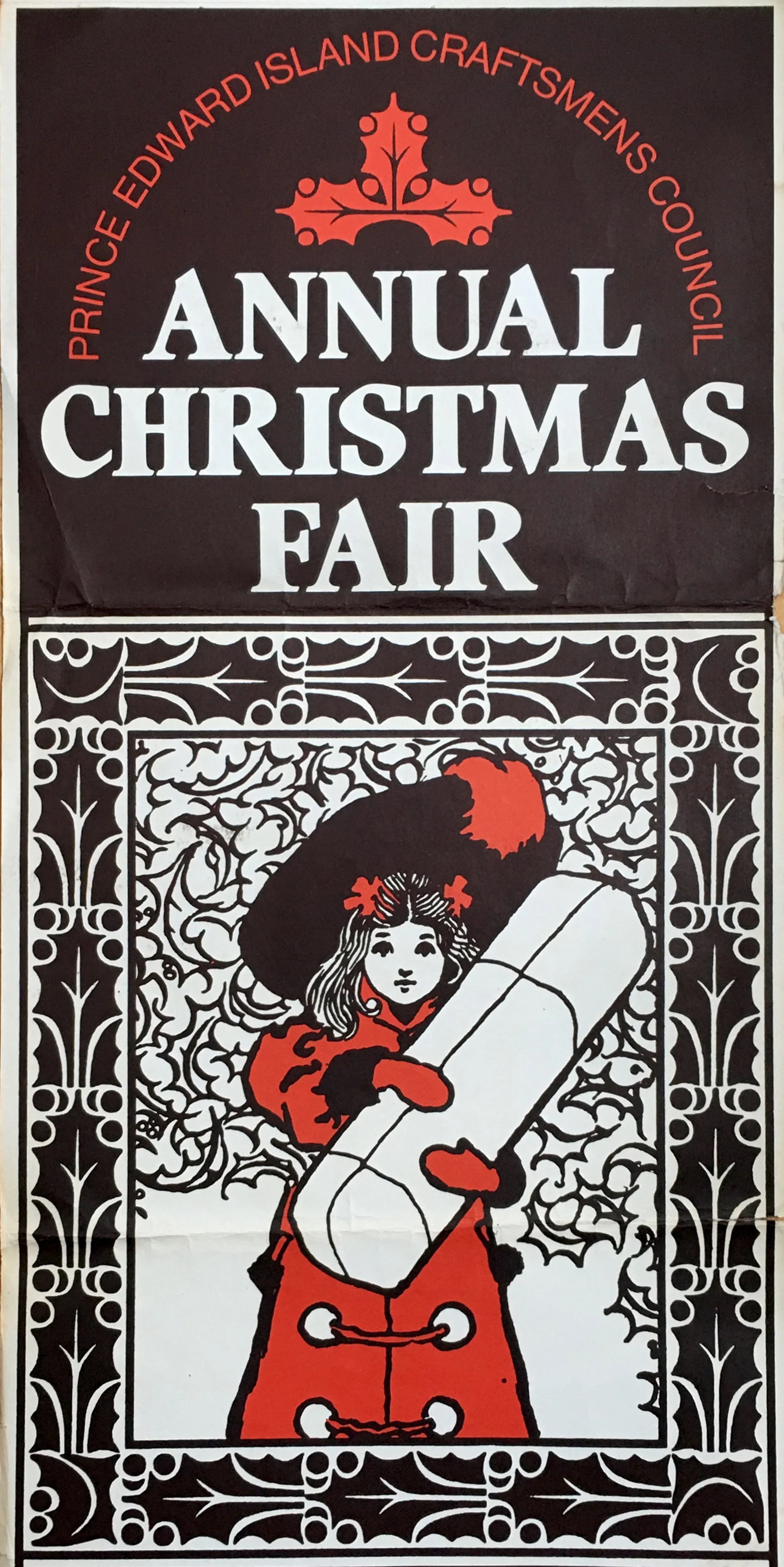
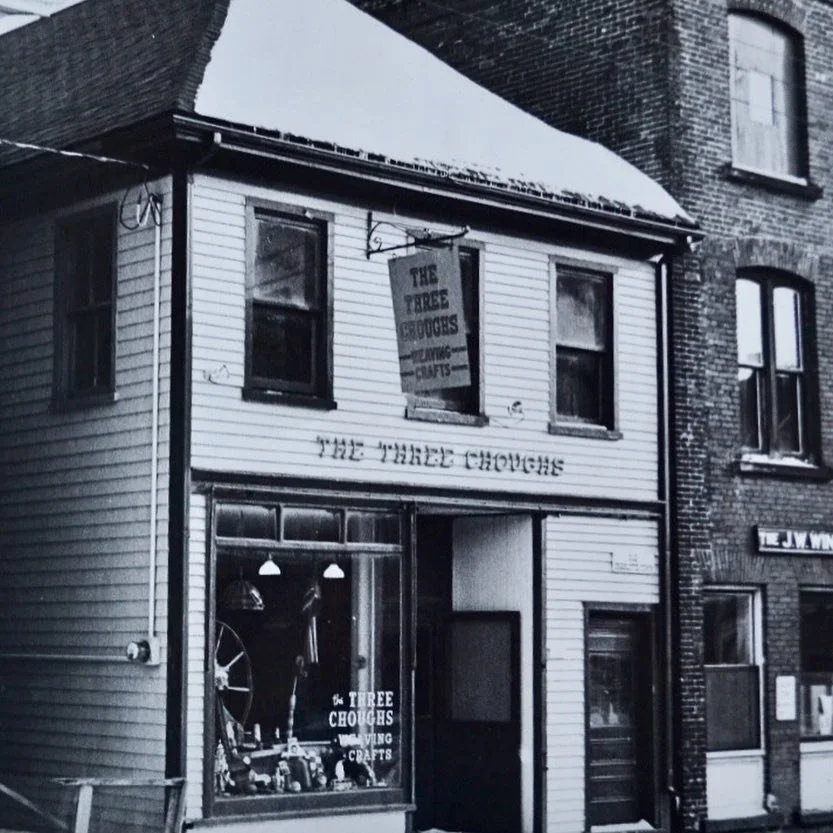
Three Choughs Weaving Studio that operated on Water Street in old Charlottetown, Prince Edward Island, during the mid-1970s. Now the current home of the PEICC.
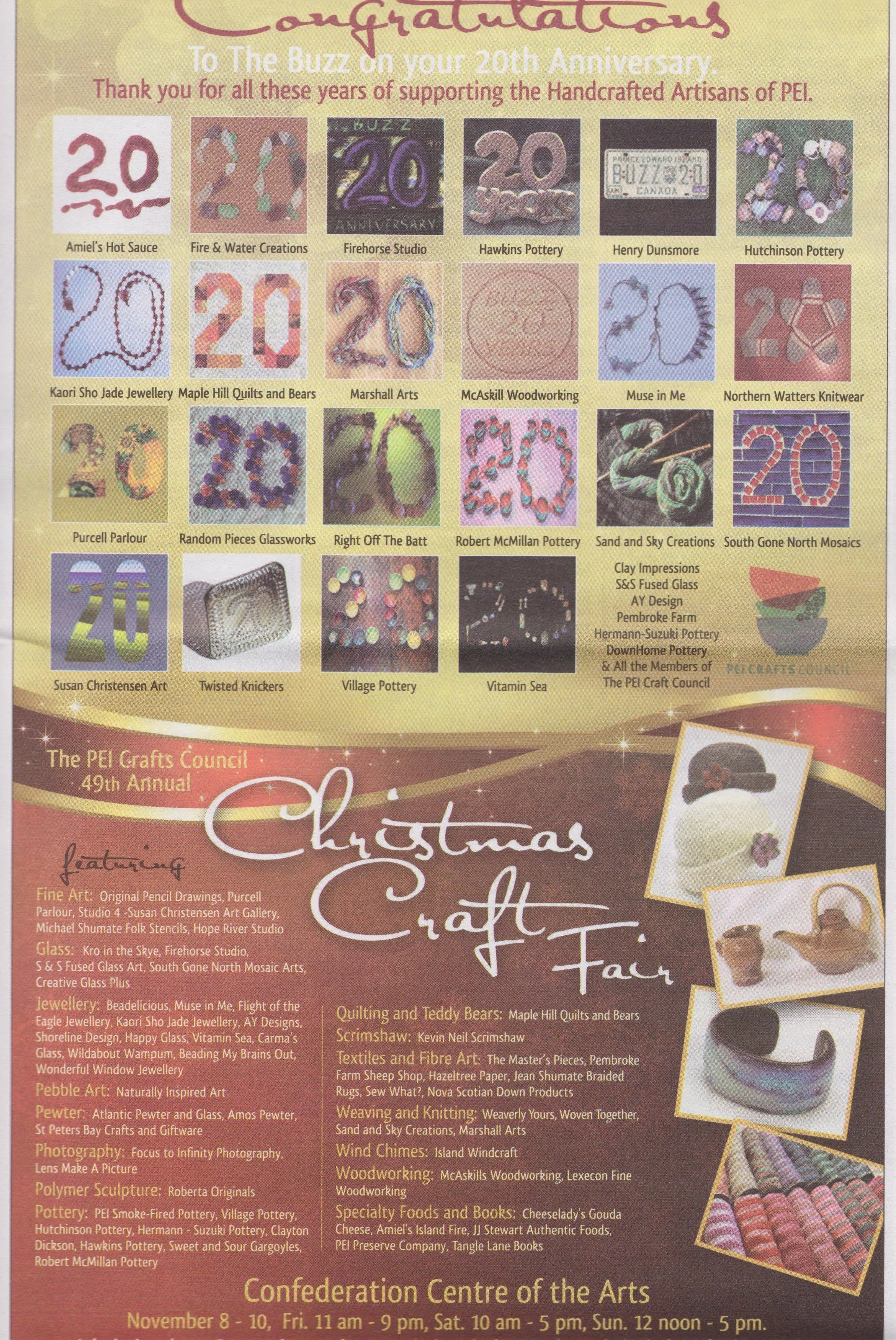
20th Anniversary of THE BUZZ and 49th Anniversary of the PEICC.
2026 - Current Staff and Board of Directors
Executive Director:
Ayelet Stewart
Board of Directors:
President: LiliAnne Webster
Vice President: Chelsea Farrell
Past President: Trudy Gilbertson
Secretary: Lindsey Ross
Treasurer: Lisa Steele
Members at Large: Charlene Miller, Susana Rutherford, Sandi Dewar, Alex Bevan-Baker and Julie Thiffeault
Product Assessment Director:
Canadian Crafts Federation:
Craft Alliance: Noella Moore
Creative PEI: Arlene MacAusland
Gallery Manager:
Claire Palmer
Professional Members of the PEICC:
PEI Crafts Council
Strategic Plan 2026 - 2029
Vision
A thriving fine craft community.
Mission
To elevate Island-made fine crafts and provide support and opportunities to emerging and established craftspeople.
Values
We value:
• Building a supportive and inclusive community of craftspeople where skills are shared, creativity is nurtured, and meaningful connections strengthen both our individual craft and our collective impact.
• Promoting and elevating island-made fine craft at every opportunity.
• Transparency and openness by communicating honestly, sharing information thoughtfully, and making decisions in ways that build trust and accountability.
Strategic Priorities
-
Island-made fine crafts are widely recognized as a symbol of quality craftsmanship.
• Objective SP1.1 - Build brand awareness for the PEI Crafts Council as a global symbol of quality Island-made fine crafts.• Objective SP1.2 - Strengthen opportunities for members to showcase their Island-made fine craft.
• Objective SP1.3 - Strengthen local and off-Island connections and engagement.
Key Performance Measures:
• Increased engagement across digital platforms
• Strong attendance and participation at Council events
• Sustained or increased relationships with funders and stakeholders
-
Members and potential members have access to the knowledge, tools, and support needed to sustain and grow their business and practice.
• Objective SP2.1 - Improve members’ access to learning and professional development.
• Objective SP2.2 - Support members and potential members at all stages of practice.
Key Performance Measures:
• Growth in overall membership numbers
• Increased member retention
-
The Studios is an incubation hub for innovation, learning, and engagement for craftspeople to create, share, and promote Island-made fine craft with the larger community.
• Objective SP3.1 – Develop The Studios as vibrant, sustainable incubation hub and Workspace.
Key Performance Measures:
• Number of users of The Studios
• Revenue or cost-recovery targets for The Studios are met
-
The Crafts Council is a well-governed, sustainable organization focused on supporting a growing, diverse membership.
• Objective SP4.1 - Cultivate a diverse and growing membership of craftspeople.
• Objective SP4.2 - Improve governance and policies.
Key Performance Measures:
• Increased diversity within the membership base
• Strong participation in member-focused activities and initiatives
• Governance and operations policies are current, documented, and regularly reviewed
» Key organizational risks are identified and managed
» Board and staff roles are clearly defined and understood
» Long-term organizational and financial plans are in place and followed
PEI Crafts Council Awards
-
1970 - Pat Johnston, Axel Johnson, Anne Rankin
1971- Dan Mullen
1972 - Mrs Elizabeth MacAusland
1973 - Sandra Myeres
1974 - Muriel Brown
1975 - Joanne Scantlebury
1979 - Al Shumate , Jean Shumate
1981 - Diane Gaudreau & Jacques Gaudreau
1984 - Trudy Coffin
1986 - Barry & Joan Jeeves
1987 - Stoneware Pottery Katherine Dagg & Sandi Mahon
1988 - Josephine Arsenault
1989 - Irene Arsenault
1990 - Carole & Ken Downe
1991 - Verna Banks
1992 - Henry Purdy
1993 - Margaret Quinn
1994 - Barbara E Henry
2000 - Joan Auld
2002 - Mary Burnett
2003 - Doreen Smith
2005 - Esther Gauthier
2015 - Ron Arvidson
2016 - Joe Mcaskill
2017 - Dean Smith & Carma Smith
2018 - Hedwig Koeszar
2019 - Jeanette Walker
2021 - Malcolm & Christine Stanley
2022 - Louise Lortie & Elaine Schuller
2023 - Daphne Large
2024 - Nora Richard
2025 - Rilla Marshall
2026 - Jane Whitten -
2015 - Susana Rutherford
2016 - Paula Kenny
2017- Laura Cole
2018 - Suzanne Scott
2019 - Ian Scott
2021 - Wanda & Bill Watters
2022 - Robert McMillan
2023 - Peter Llewellyn
2024 - Debbie Miller & Charlene Miller
2025 - Michelle MaCallum & Shannon Pratt - Innovation PEI
2026 - Yvonne Duivenvoorden - Ally Street Clay Club
The Lister Trophy: Awarded annually to the Outstanding Island Artisan by the PEICC.
In memory of Percy & Muriel Lister for their contribution to island handcrafts 1963-1970.
Craft Community Supporter Award: Awarded annually for Outstanding Contribution to the PEI Crafts Coumminty.